Even though it was only announced a few days ago, Apple’s iPad already has me thinking about how app developers will use the large, high resolution display to make learning Chinese easier than ever before.
Studying Efficiently
Over the last few years we’ve seen a huge jump in the accessibility of every kind of study aid you can imagine. From dictionaries, to flash cards, to edutainment, literature, and guides to idioms, there are hundreds of applications available on the iPhone for learning Chinese that are fun and easy to use. Flipping through flashcards or tracing characters with your fingertip is a more engaging and interactive learning experience than sitting through a dull class or flipping through textbooks. Which means you’re more likely to stick with it and see results.
Four Key Features
Some of the standout features that make the iPad great for learning Chinese:
- A bright and clear 9.7″ screen, great for displaying a lot of characters and dictionary entries. On a device more portable and more svelte than any laptop.
- It’s Wi-Fi enabled, so you can download new vocabulary lists or use online dictionaries like Nciku wirelessly.
- Uses multi-touch technology so you can write characters with a stroke of your fingertip, or flip through flash cards with speed and ease. Chinese support is built in.
- Access to hundreds of apps made specifically for studying Chinese, available now in the app store for the iPhone and iPod touch. They’ll all work on the iPad.
Application Development & Porting Existing Apps
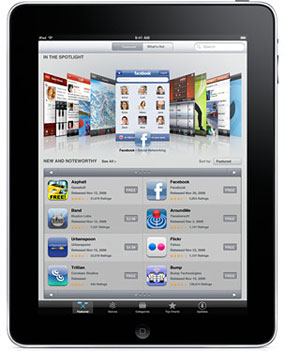 If you search for “Chinese dictionary” in the App Store, more than 25 variations emerge. They mostly offer similar features, but the abundance of dictionaries demonstrates the size of the Chinese learning market: it’s huge and growing quickly. Application developers will be updating their offerings and creating new ones especially for this device, which means that as with the iPhone, the sky is the limit.
Any study aid that you can probably think of has either already been made or is in development. A year from now, this thing will most likely have produced new and innovative applications that we can’t even imagine now. Utilizing these more efficient tools and techniques will enable you to spend less time acquiring your language skills and more time actually using them.
When it’s released in a month, all existing applications for learning Chinese (read about our favorites) will work from day one. Apps that aren’t updated to support the iPad’s higher resolution will display either in their native format, which will look tiny on the iPad, or in a blown-up full screen version. This is important whether you’ve paid $149.99 for the Pleco Complete Bundle or if you’re just comfortable with the Qingwen dictionary app and don’t want to switch to another.
iPad’s Competition: Big and Small
If you’ve been studying with paper and textbooks for years, you know that these are time-tested methods which work. What the iPad and it’s competition offer, however, is a more streamlined and efficient method for language acquisition. Using modern techniques like intelligent flash cards will only drill you on the words and phrases that you have trouble with, cutting down your study time significantly. If you’ve found yourself getting bored and giving up after writing 200 characters a day (like one of my friends recently has), utilizing methods like these can make all the difference.
Internet-connected Laptops & Desktops
They’re more powerful and versatile but sometimes they aren’t as effective because they’re slow, cumbersome, and mired with distractions. It takes a lot of typing, clicking, and waiting to get a definition online in your browser. If you want to investigate a character, word, or phrase, you might get distracted by incoming e-mail or IM’s and lose your direction. If your home computer is off and you have to turn it on, you might not even bother after waiting so long. If you want to review flash cards for just a few minutes, you might not bother if you can’t do it immediately and at your whim.
Let’s say you hear an unfamiliar word in conversation and want to find the definition right away. The faster you can execute this action, the more likely and often you are to actually use it.
E-Dictionaries and the iPhone & iPod Touch
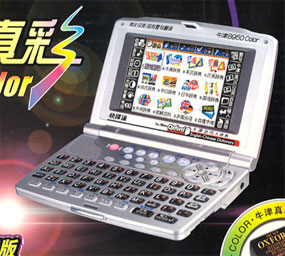
E-Dictionaries are costly and unwieldy at the same time. They have tiny displays, cramped keyboards, and you can’t write characters. The graphics generally resemble Windows 3.1, they have a limited number of functions, and they still cost up to $400.
The iPhone and iPod Touch, however, are great tools for learning Mandarin. They will run the bulk of Chinese learning apps in the app store and feature nearly all the same technology as the iPad. What they lack though, is the larger resolution display and faster speed due to the new A4 processor designed by Apple. With these allowances, developers can improve the function and features of basic tasks that we use to study everyday.
The iPad comes out in March and starts at $500.
What do you think of the iPad? Leave a comment!
I wonder if they will release apps that take advantage of the platform. It probably won’t take off like the iPod, I’m thinking.
I can’t imagine it blowing up like the iPhone/iPad, but for serious travelers, students and businessmen it should take off.
dvds on a plane?
Beyond the apple obsessed I don’t think many people will be buying an ipad. An atom based netbook or touchpad running windows 7 is much more functional and cheaper. Business users already have their laptops and ipods/iphones. The kindle makes a better e-book reader. This is just another gadget that in the long run will end up forgotten in the back of a cupboard.
I’m skeptical, since netbooks don’t excel at anything and the Kindle is a one-trick pony. Even if the iPad is only successful with students, which is possible but unlikely, it won’t have been a failure. I don’t think it’s success or failure in the larger market will have a large impact on it’s usefulness as a language learning tool, because of the App Store and the ease of developing apps and getting them in the marketplace cheaply and quickly. Critics are abound over the lack of multi-tasking (which does suck), but I see this easily trumping netbooks considering how much better this will be to use for the few minutes at a time that netbooks are made for.
Sales numbers are looking quite impressive after the first day of pre-orders! http://tinyurl.com/yk7kw5u
In hindsight this comment is pretty amusing.
Yeah it is, hahah. I don’t want to rub his face in it since Ben is a good friend and very knowledgable about computers in general, but he failed to call that one.
A few months ago iPad was named the fastest selling consumer electronics device in history.
personally I think it will be big. I have a desktop and a netbook but I think the Ipad could be the thing that I’m missing. My netbook is great, but not convenient to pull out anywhere and wait for loading times as Charlie mentioned. Perhaps it’s all hype and what it actually does is nothing new or special. We’ll see.
Here’s a great article I came across today about the iPad: http://tinyurl.com/yef5k4q
It’s good to hear that there are people so credentialed who foresee the iPad being such a huge commercial success.
Chalk me up as a person with an iPad looking for a good Chinese English dictionary app. The iPhone apps don’t always translate well and if I’m going to spend $50+ on an app, i want it optimized for the iPad.
Anyone else in Asia get one yet?
David,
Are you in China? In Chengdu I inquired at an Apple Store (official retailer) on the US iPad launch day and they said they aren’t sure when they’re getting them in China or what the price will be. It seems that currently, the only option is importing one. Yesterday I visited a local iPhone/iPad app developer in Chengdu (a post on that is forthcoming) and they don’t even have one yet.
About Chinese study apps on iPad, it looks like there’s only one chinese/english dictionary currently in the app store: http://itunes.apple.com/us/app/id363507998?mt=8
I expect more to get released over the coming weeks, although I suspect the big ones (like Pleco) will take quite a long time (3+ months) before they’re released. The sky is the limit though as far as features and capabilities – I can’t wait to see how it goes.
I’ll make arrangements to have an iPad shipped here from the States if I don’t get info on the release here, soon. I expect them to be significantly more expensive than what buying one in the US and having it shipped here would cost (like Apple computers).
I’m in Taiwan. Not sure how far that is.
I heard that the international release date is targeted for April 24th, but like all things Apple, you never really know until a couple of days before.
That might actually be good timing since OS4 is going to be shown tomorrow.
I downloaded two apps. ‘I Love Chinese’ and another one I can’t remember the name of. Overall, they seem hastily put together and the interface isn’t great. But th ats to be expected from first gen apps. Most of the apps I’ve tried have been pretty buggy.
What do you do in Cheng Du.
I was looking at the pre-release iPad version of Twitbird yesterday and came to the same conclusion: it’s just an upscaled iPhone app on a huge screen. For this reason, they decided not to release it into the App Store on day one, but to further develop it to take advantage of the large screen on the iPad. Good move. I expect that in these early stages a lot of iPad apps are lazy rehashes of iPhone applications. In the long term though, I’m confident that the iPad will blossom as a great learning resource.
I’m a designer and musician in Chengdu, but most of my clients are overseas. I made and manage this site as well. Welcome 🙂
Sorry I’m a little late to the conversation. I was curious though, if any of you have acquired an iPad 3G in China. If so, does it work well? Did you have to jailbreak it?
I don’t think an iPad 3G will work (wirelessly) in China. Matter of fact, it won’t even work in the US on any wireless network other than AT&T.
I recently jailbroke my wi-fi iPad though and it is awesome.
🙂 That’s cool.
In the original post you had high hopes that the iPad would be an awesome language learning tool. Has it fulfilled your expectations? I just downloaded the Pleco app the other day, and I think it’s just about all I ever wanted to have in a dictionary when I lived in China. Can’t wait to get back there and try it out.
As far as language learning goes, the iPad is definitely still in its infancy. I expected this to be the case though, as the iPhone and iPod Touch were the same way. Over the next year the number and variety of iPad apps will explode, to certainly include apps tailored specifically for Chinese learners. Right now Pleco is available on iPad but it’s a mediocre implementation (a quick iPad conversion, which is what most language learning apps on iPad are currently).
Otherwise though, the iPad has exceeded my expectations. I use it a lot everyday because for a lot of functions it’s much more enjoyable than using my laptop, desktop or iPod Touch. It feels like the future, that’s for sure.
I think you’re right about the iPad feeling like the future. I’ve been especially excited about the possibilities for immersive language learning games. I hate memorizing lists of vocabulary, and would like to disguise the pain ;-).
It seemed like such an opportunity to me, that my wife and I started developing an iPad game together. She’s been doing the graphic art and I’ve been doing the programming. We submitted it to the app store last week, and are waiting approval. 🙂
Post here when you get approval! What’s the name of the app? Good luck with it-
It’s been accepted now for almost a week! It’s called Pum Chinese. (In case you’re wondering “Pum” is the sound of a bubble popping).
The link in the app store is http://itunes.apple.com/us/app/pum-chinese/id373373824?mt=8, or it’s linked from http://www.pumthegame.com.
Language Master from Hooray is a great app to check out to learn Languages on the ipad or iPhone. http://www.languagemastersuite.com
http://www.hooraysociety.com
German developer Klaus did a great job on the KT-dict app for the iPhone and Touch. I’m typing on the iPad right now and it’s level of ‘interaction with data (especially news sites like these)’ are amazing.
I find writing strokes on the iPod doable after some practice but even then you’ll f*ck it up 20% of the time given it’s tiny screen. The writing space on the iPad is very big, a bit larger than the entire screen of the iPhone.
I might even start to enjoy classes at 川大 again once they publish a ktdict native iPad app.
Ps. Both the ipad’s pinyin and handwriting input are blazing fast and the nice thing is you can keep typing a long ass sentence, it will compose the exact sentence you intended, just like on the MacBook. Amazing software, worth the money!
Seriously, good apps for learning Chinese can’t come soon enough to iPad. I’ve thought seriously about buying Pleco for iPad but from the demo it looks like they did little customization on the iPad version.
I used KT-dict as my main dictionary/flashcard app for over a year and recently tried out HippoDict. It is awesome. There are really a ton of great resources for people learning Chinese using an iPod Touch or iPhone.
Are you using any dictionaries or flashcard apps on the iPad Jord? “Flashcards” is available on iPad and the developer made it to study Chinese flash cards but it doesn’t offer much of a practical advantage over the iPhone version. iPad really needs a dedicated app built for that platform.
Yo Charlie, no, I haven’t found any proper chinese learning app due to the lack of them. I did google and browse the app store a fair bit and am intrigued by the huge demand for an app like this. I did find http://www.ilovechinese.co.uk – from a true ‘Chinese (academic) studying’ point of view it looks shitty, and won’t make it to the masses the way I see it.
The perfect app for me would be based on a similar platform as KT-dict
– Apple layout / color schemes (no BS design)
– iPad compatible
– Stroke order animation
– ‘smart memory’ characters (software learns as you search)
– Chinese news & article integration/instant translation like http://www.clavisinica.com/
There is a huge market, and not only for chinese apps.
If I were to find a good co-founder / C++ writer I would build it myself!
Hey Jord-
Apps like these are coming, there’s no doubt about it. The iPad app market is about 6 months old at this point but at this point there’s nothing that’s really topping Pleco – even though it comes at a pretty high price.
Nciku has a line of Chinese eBook applications on iPad which are really cool. Check it out on their blog: http://blog.nciku.com/blog/en/?p=1767
I’m surprised that Dianhua, KTDict and the others (recently I’ve been using HippoDict as my main dictionary) haven’t released iPad versions yet! One possible explanation for why they haven’t come out yet is that they want to make the application custom-tailored for the iPad which is really important. When Pleco first got iPad compatibility it really seemed like a rushed port that was just a blown up iPhone application.
When there are some more apps of this type I’ll buy them and author a follow-up to this post!
A big issue from the app creating side of things is that creating per-word content takes a lot of time. Of the list you mentioned above, stroke order animation would be a huge expense to produce. If you could find a cheap vendor for the animations, it might be worthwhile.
However, as a developer with a couple language-related apps on the app store I’m under-whelmed with the “huge” market. I’m a technical guy, not a marketer though, so that might be some of the problem.
Market-wise, let’s not forget the iPad is still not widely available in China like the ipod Touch & iPhone. On top of that, Chinese credit cards are not accepted to set up a iTunes account which prevent the non-technical crowd to start downloading app’s like in the West. Apple will set up 28 native Apple stores in China (following up on Beijing & Shanghai) the coming 2 years or so, so I expect they will increase their sales / service network on the mainland. I find their current resellers useless.
Travis, can you send me your mail address, have some other questions related to app development, thanks
tjlittle~at~gmail~dot~com
Any updates on this? Have you been using iPad to study Chinese?
Yes, I have. The market for iPad apps for learning Chinese is still developing but these are the ones that I have installed and use:
– Pleco (universal app, works for iPhone & iPad)
– Chinese LS (great for writing full screen)
– eZiTest2 (bad name, great app for writing)
– Pinyin (native iPad pinyin trainer with spoken word)
– ShuBook (great for finding Chinese language ebooks)
Charlie, have you tried HanZi Reader? It’s my attempt at an iPad reading app. I could send you a promotional code if you want to try it.
Hey Robert,
I haven’t tried Hanzi Reader. If you want to send me a promo code I’d be happy to check it out and give you feedback and a review in the App Store. You can email me at [email protected]
Thanks for the write up Charlie. We are currently working on an iPad app that teaches people how to write Chinese characters and we are looking for beta testers. Would really love to get your thoughts on this. Would you be interested in checking it out?
The app is WordTrace (the name is not finalized yet) You can see some of the screenshots here: http://www.nanaimostudio.com/wordtracer
If I can limit the characters show to food characters, I’d certainly be interested in testing your app. entropy at io.com will reach me. 🙂
Quick note to share word of the Popup Chinese Chinese Writer for iPad. Fun and free interactive app that looks gorgeous and uses touch-interactive tech to test if people are drawing characters properly.
http://itunes.apple.com/us/app/chinese-writer-for-ipad/id438875925?mt=8
The app starts with a 25 character tutorial that introduces the basic rules to write characters, and can be unlocked (for free) to release a practice mode with support for more than 1000 additional characters.
Very cool. Thanks for letting me know. I’m authoring a followup to this post and will include this. Great app, thanks for keeping it free!
Just wanted to share with you that our iPad app Word Tracer – Learn Chinese is up on the App Store.
http://itunes.apple.com/us/app/word-tracer-learn-chinese/id430413408?mt=8
We have a few promo code left that we can give out. If you are interested, please email me.
I’d like a promo code (and I emailed you via your website already.)
It would be really awesome to have a version that only included food words, so you could practice writing the things you will read at a restaurant, and also practice writing your order out in Chinese.
~ Kiran ([email protected])
Hi Kiran, I have emailed you the promo code and added your request to our list.
Hi Boon,
Do you still have anymore promo code?
Thanks!
Hi EC, sorry we ran out of promo code (except for a few that we have reserved for review sites). The app is currently featured on App Store as a Staff Favorite. I think you will find it useful. If you are not happy with the app, we will gladly refund your purchase.
So far, this looks really awesome. It would be nice if it were a universal app for iPad and iPhone since many of my foodie friends have one or the other but not both. It’s unfortunate this wasn’t around when I was first learning stroke order, lazy year, because it’s really an excellent practice tool.
It occurs to me that if food terms were included, pictures of the food would be useful. My goal is to become fluent in restaurant Chinese, after all, not the whole language. :-/
Better Chinese, LLC is a textbook company for teaching Chinese that’s been transforming their textbooks for the interactive iPad environment. They just did a pilot with Stanford University and the Palo Alto Unified School District and the iPads proved to be rocket fuel for the students wanting to learn Chinese.
http://ed.stanford.edu/news/ipads-become-learning-tools-teens-learning-mandarin
Unfortunately, nothing I read in the Stanford article supports the claim that the iPads proved to be “rocket fuel”.
This is unfortunate, because my own experience does lead me to believe the claim IS true, and I’d like some evidence to support it.
And the only app I see on the iTunes store from “Better Chinese LLC” is Piggy Picnic, which doesn’t really seem anything like a textbook to me.
Hi,
I teach Chinese at spare time for a few years, and found that many beginners have the same question,”how to practice Chinese writing?”
Unlike other languages, it takes a lot of time and effort to learn and practice Chinese writing, and I was thinking how to make it easier and more interesting. That’s how I developed the iPhone/iPad application called “EZ Mandarin”, in order to help you learn and practice Chinese characters at any time anywhere. Try today and hope your Chinese learning journey a lot of fun!
Find it at: http://itunes.apple.com/sg/app/ez-mandarin/id400174832?mt=8
If only there were more GOOD Cantonese apps in the appstore. I’ve found a few apps, but in a word, they’re generally just kinda “meh…”
You’re so right. Cantonese learners really have it tough compared to those learning Mandarin. With Mandarin you’re practically flooded with resources. Good luck though, committing to Cantonese is a noble endeavor in 2012.
Thanks again for a terrific site. My 1st goal now is to learn to speak & write Mandarin. Read all I could about the iPhone & iPad. I have decided that the iPad is the best call. Sells for 3000,has a bigger screen. So it is cheaper and easier to read & write and the apps available are the same. The only negative is that I can’t use it as a phone but I dont need to.
I have a 3G Data card that takes a sim. Should be able to connect wirelessly with this so I can download apps.
TalkingLearn – Learn Chinese is your best spoken language training partner. This app is dedicated to helping mobile people make full use of their spare time to practice oral Chinese. It covers the courses ranging from Life, Business, Traveling, Entertainment, Early childhood to many other categories in different difficulty degrees. In addition, it collects lots of useful Mandarin phrsases for you to use in your everyday conversations.
Download it at: http://www.talkinglearn.com/